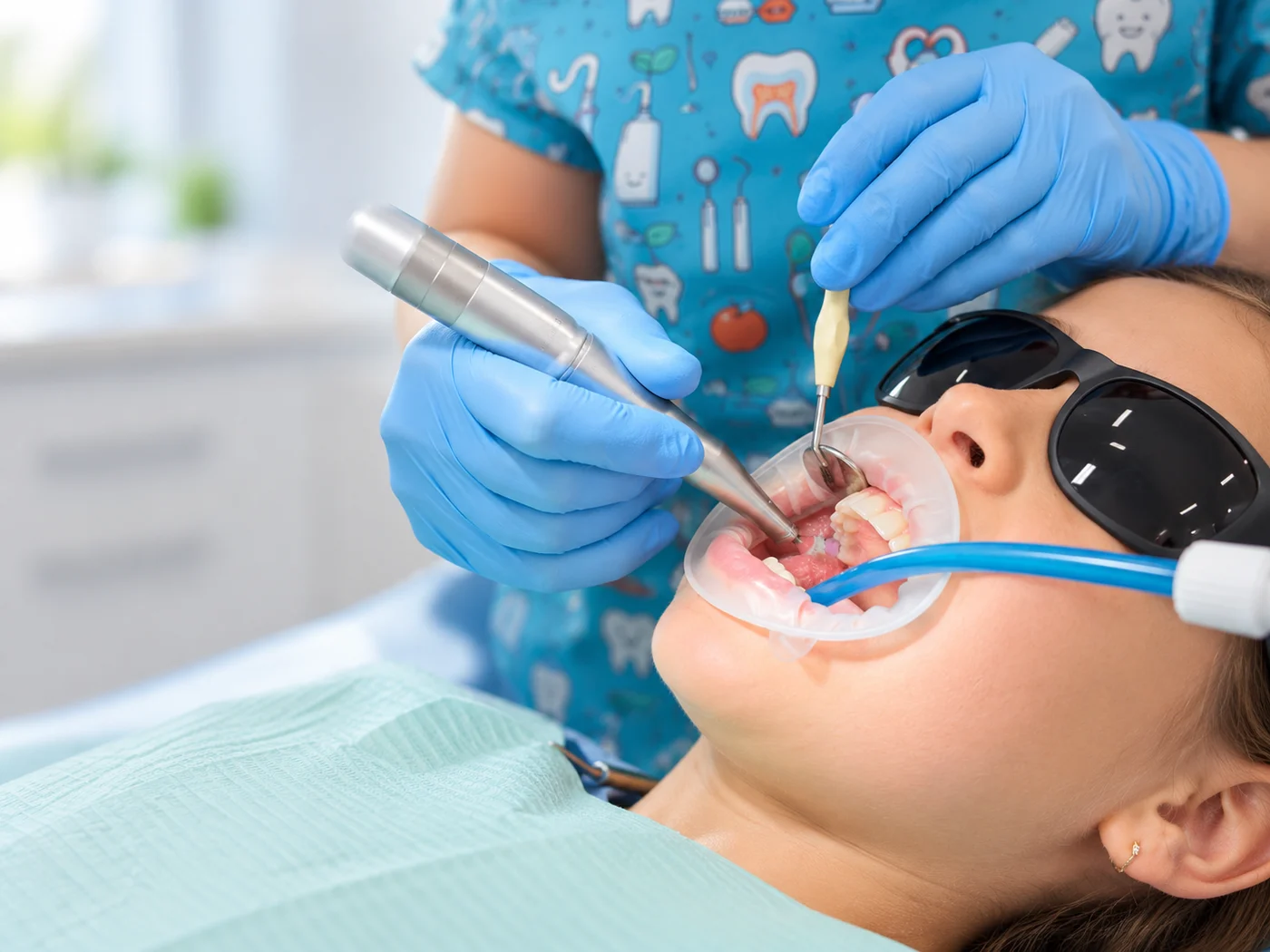
What restorative dentistry involves
Tooth decay is a process in which bacteria break down enamel and dentine. Early lesions can sometimes be halted with fluoride treatment, but a cavity requires removing the affected tissue and placing a filling.
A composite filling is colour-matched to the tooth and cured with light. For larger cavities, an adhesive restoration is used, sometimes reinforced with glass fibre. Bonding makes it possible to improve the shape of front teeth without grinding or with minimal preparation.
Restorative dentistry at LumiDent: step by step
- ExaminationAssessment of the cavity and, if needed, an X-ray.
- Anaesthesia and isolationLocal anaesthesia and keeping the tooth dry, e.g. with a rubber dam.
- Removing decayPreparing the cavity while preserving healthy tissue.
- FillingApplying composite in layers, curing and polishing.
We plan treatment for the whole mouth, not just a single tooth. Our dentists agree the treatment plan and the order of procedures together – from fillings and root canal treatment to prosthetics, implants and orthodontics. You receive the plan together with a cost estimate.
Restorative dentistry
Usually considered when:
- a tooth reacts to sweet or cold things
- you can see dark discolouration or a cavity
- an old filling is leaking or cracked
May not be suitable when:
- the tooth aches spontaneously or at night – it may need root canal treatment
- the cavity is very large – an onlay or crown may be a better solution
Prices: Restorative dentistry
| Gradia Direct / G-ænial composite filling: | |
| 1 surface | 320 PLN |
| 2 surfaces | 400 PLN |
| 3 surfaces | 490 PLN |
| 4 surfaces | 570 PLN |
| Estelite Asteria composite filling: | |
| 1 surface | 370 PLN |
| 2 surfaces | 450 PLN |
| 3 surfaces | 540 PLN |
| 4 surfaces | 620 PLN |
| Adhesive build-up: standard / with glass fibre | 670 / 820 PLN |
| Tooth wall build-up | 250 PLN |
| Medicated / insulating liner | 100 PLN |
| Composite veneer (bonding): standard / complex | 870 / 1 020 PLN |
| Use of microscope in caries treatment | 150–420 PLN |
| Dentine hypersensitivity treatment – 1 tooth | 70 PLN |
| Infiltration anaesthesia | 50 PLN |
| Rubber dam (tooth isolation) | 50 PLN |
Prices are indicative. The exact cost is set by the dentist after an examination and included in your treatment plan. See full price list
Who performs restorative dentistry



Before and after your visit: restorative dentistry
- After anaesthesia, don't eat until the numbness wears off (usually 1–3 hours).
- The tooth may be sensitive to cold for a few days.
- Regular check-ups make it possible to treat decay at an early stage.
Questions about restorative dentistry
How long does restorative dentistry take for one tooth?
Restorative treatment of one tooth with a composite filling usually takes 30 to 60 minutes. The time depends on the size and location of the cavity. Extensive adhesive restorations may take longer, and with several teeth the dentist may suggest splitting the treatment into more visits.
Does restorative dentistry require anaesthesia?
Restorative treatment of shallow cavities sometimes does not require anaesthesia. With deeper decay, the dentist usually offers local anaesthesia to make the procedure comfortable. You decide together before starting, and the cost of anaesthesia is listed in the price list.
How long does a filling last after restorative dentistry treatment?
The durability of a filling after restorative treatment depends on the size of the cavity, bite forces, oral hygiene and habits such as teeth grinding. Large fillings in back teeth wear faster. Regular check-ups make it possible to replace a filling before it starts to leak.
Articles about restorative dentistry
The first articles on this topic are in preparation.