Can receding gums be reversed? Gum recession and when treatment is needed
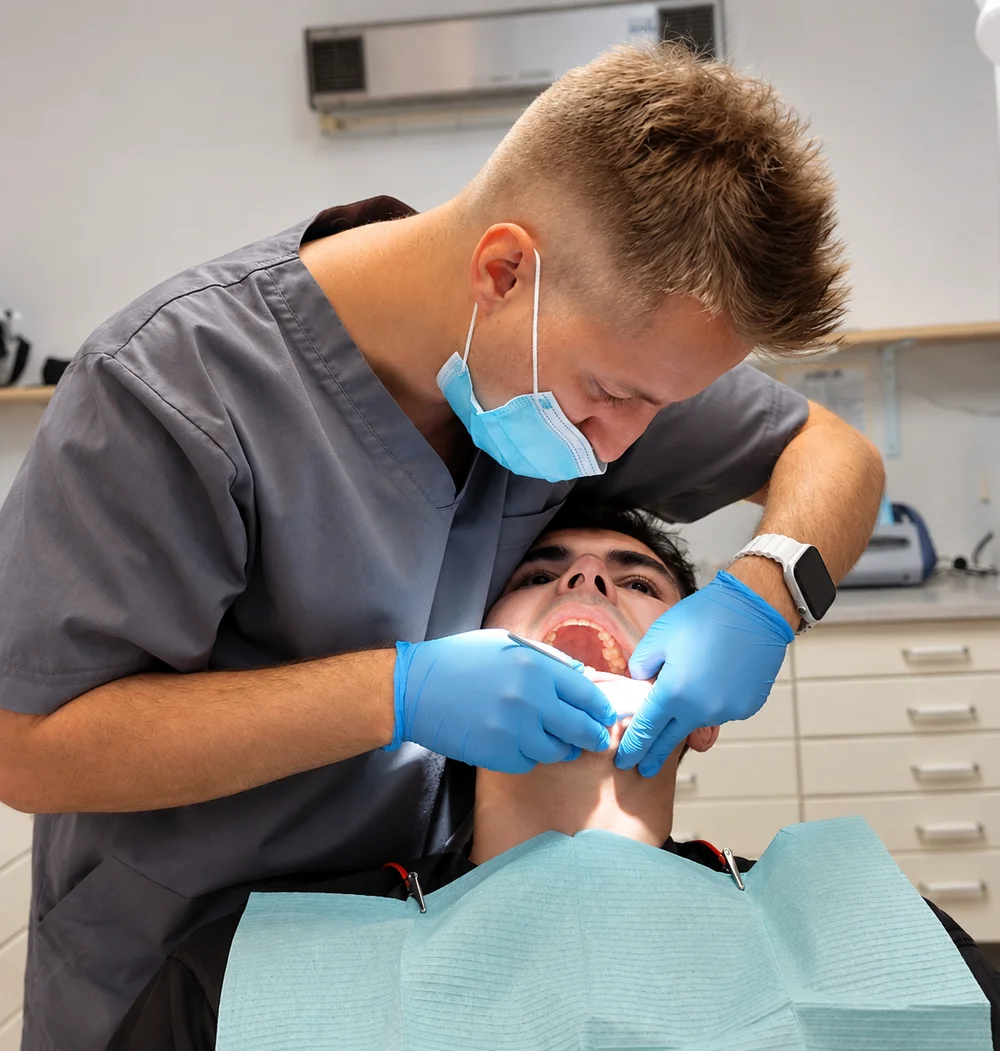
Can receding gums be reversed? Gum tissue that has receded does not grow back on its own – not with a new toothpaste, not with mouthwash. Removing the cause can stop gum recession, and the exposed root can be covered again only with surgery, which in many cases gives a predictable result.
At consultations we often hear: "my teeth look longer", "the neck of the tooth reacts to cold", "there is a darker strip near the gum". In this article we explain what gum recession is, where it comes from, when it is enough to monitor it, when treatment is worth considering, and what that treatment involves.
Gum recession: what it is and how to recognise it
Gum recession means the gum margin has moved down towards the root, exposing part of the tooth root. The root is not covered by enamel, so it can be sensitive, usually has a more yellow colour and wears down more easily.
Recession is very common. In a review of epidemiological studies, about 50% of adults aged 18–64 and about 88% of people over 65 had at least one site with recession. It occurs both in people who look after their teeth very carefully and in those who don't.
Typical signs of gum recession:
- a tooth looks longer than its neighbours,
- a strip of root is visible near the gum, sometimes with a "step" you can feel,
- the neck of the tooth reacts to cold, sweet things or brushing,
- dark triangles appear between teeth near the gum,
- a wedge-shaped notch forms at the neck of the tooth.
Small recession often causes no symptoms at all and is first noticed by a dentist or hygienist during a visit.
What causes gum recession: the most common reasons
Recession rarely has a single cause. Usually the structure of the gum combines with factors that irritate or strain it.
- Thin gum and thin bone. People with thin, delicate gums (the so-called thin phenotype) are more prone to recession. This is an inherited trait, not the patient's fault.
- Gum disease (periodontitis). Inflammation destroys the tissues that hold the tooth, and as it heals the gum often shrinks towards the root.
- Brushing habits. Studies most often linked recession to horizontal scrubbing, hard bristles and long, frequent brushing. The evidence is not conclusive, but dentists usually recommend a soft brush and a gentle technique.
- Tooth position and orthodontic treatment. Teeth that sit outside the bone contour are more prone to recession. In a review of studies, teeth tipped further forward during orthodontic treatment had recession more often in most studies, although the differences were usually small.
- Fillings, crowns and veneers near the gum. Leaky or overly thick margins encourage plaque build-up and inflammation.
- Other factors: smoking, lip or tongue piercings, a high frenum attachment, teeth grinding.
Finding the cause is the first step of treatment. Without it, recession can keep progressing and may even partly return after successful surgery.
Can gum recession reverse on its own?
No. The body does not rebuild lost gum tissue by itself. Sometimes, after inflammation has been treated, the gum margin becomes smoother and swelling goes down – this can look like a slight improvement, but a root that was exposed stays exposed.
Online you can find toothpastes, mouthwashes, oils and supplements that claim to "regrow gums". There is no research to support this. Such products may help with plaque control or reduce sensitivity, but they will not cover the root.
What non-surgical treatment can realistically do:
- it can stop recession if the cause is removed (changing brushing technique, treating inflammation, replacing a leaky filling),
- it can reduce sensitivity of exposed necks of teeth – toothpastes for sensitive teeth, varnishes, sometimes a filling for a notch at the neck,
- it cannot restore gum tissue where it is already gone.
Does untreated gum recession get worse?
Often, yes. In a systematic review of studies where recession was left untreated for at least 2 years, about 78% of recession sites got deeper, and the number of recession sites among the patients followed rose by roughly 79%. Importantly, these were people with good oral hygiene.
This does not mean every recession needs surgery. According to a review prepared for the 2018 World Workshop on classification of the American Academy of Periodontology and the European Federation of Periodontology, when there are no symptoms or disease, monitoring the site is usually the proper approach: measuring the recession, assessing gum thickness and checking whether it changes.
Gum recession: when monitoring is enough and when to consider treatment
At the consultation the dentist measures the depth of recession, assesses the thickness and width of the gum, checks for inflammation and asks what bothers the patient. Based on this they suggest monitoring or a procedure.
| Monitoring gum recession is usually enough when… | Gum recession coverage is worth considering when… | |
|---|---|---|
| Size | recession is small and does not change between measurements | recession is getting deeper or new sites appear |
| Symptoms | there is no sensitivity, or toothpaste easily controls it | the neck of the tooth stays clearly sensitive despite treatment |
| Gum | the surrounding gum is thick and healthy | the gum is very thin or almost absent |
| Treatment plans | no treatment is planned that will strain the gum | braces, a crown or a veneer are planned for that tooth |
| Appearance | the recession does not bother the patient | exposed roots spoil the smile |
The decision is always made by the dentist after an examination, together with the patient.
How gum recession can be covered: surgical methods
Recession coverage procedures belong to periodontal plastic surgery. They are done under local anaesthesia, on healthy, clean gums – which is why they are usually preceded by a professional cleaning.
The most common techniques are:
- coronally advanced flap – the dentist gently releases the gum and moves it so that it covers the exposed root,
- tunnel technique – the gum is lifted without cutting the papillae between the teeth, and a graft is placed underneath; it is often chosen for several adjacent recessions,
- Zucchelli technique – a variant of the coronally advanced flap for covering several adjacent recessions.
With any of these methods a connective tissue graft, usually taken from the palate, or a collagen matrix that replaces the graft can be placed under the gum. Sometimes an enamel matrix protein preparation is used as well.
What the research says:
- In a large systematic review of 51 clinical trials, a coronally advanced flap combined with a connective tissue graft gave the best results for single recessions – it achieved complete root coverage more often than other methods.
- The 2018 Cochrane review (48 trials) confirms that a connective tissue graft gives a slight advantage when, besides covering the root, the gum also needs to be thickened. A coronally advanced flap alone or with biomaterials is also effective.
The method is chosen according to the type of recession, gum thickness and number of teeth. Prices of individual procedures are on the page gum recession coverage and gum surgery at LumiDent.
Does gum recession coverage always give a full result?
Not always. The most important factor is whether bone and attachment have been lost around the tooth between the teeth:
- if the attachment between the teeth is preserved, complete root coverage is often possible,
- if it is partly lost, complete coverage is possible but less often – frequently the root can only be partly covered,
- if loss between the teeth is significant, complete coverage is usually not possible – but surgery can still thicken the gum and stop further recession.
This approach is described by the Cairo recession classification, which is used worldwide today. The result is also affected by smoking, oral hygiene and whether the cause of the recession has been removed.
Who gum recession surgery is not right for – at least for now
- when there is active gum inflammation – a professional cleaning and treatment come first,
- when recession is the result of untreated gum disease that is still progressing,
- for heavy smokers – smoking clearly worsens healing and results,
- with uncontrolled diabetes or certain medications – a consultation with the treating physician is needed,
- when the cause is still active (for example scrubbing with a hard brush) and the patient isn't ready to change it.
This is general information. The final decision is always made by the dentist after an examination.
How to stop gum recession day to day
- Use a soft toothbrush and don't press hard. Brush with movements from the gum towards the tooth or with small circles, not horizontal scrubbing.
- Clean between your teeth with floss or interdental brushes – gently, without forcing them into the gum.
- If your teeth are sensitive, use a toothpaste for sensitive teeth.
- Come for regular professional teeth cleaning and check-ups – removing tartar and plaque reduces the inflammation that contributes to recession.
- If you grind your teeth, ask your dentist about a night guard.
- If you are planning orthodontic treatment, ask for a gum assessment before your braces are fitted.
Gum recession treatment at LumiDent
At LumiDent in Ursynów, periodontal surgery, including gum recession coverage and gum thickening, is performed by Dr Orest Shtuka – a dentist in practice since 2000 who works in oral surgery, implantology and surgical periodontics. He speaks with patients in Polish, Ukrainian and Russian.
How treatment works:
- Consultation – gum examination, recession measurement and an X-ray if needed. The dentist explains the cause of the recession and tells you whether monitoring is enough or a procedure is worth considering.
- Preparation – professional cleaning, treatment of inflammation, brushing instruction.
- Procedure – under local anaesthesia, with a method chosen for the type of recession. You know the cost before the procedure.
- Healing and check-up – written aftercare instructions; stitches are usually removed after 10–14 days, and the tissues fully mature over several months.
Want to find out whether your recession needs treatment? Book a consultation online or call +48 732 205 427. We are open Monday to Saturday, 10:00–21:00, ul. Alternatywy 7 lok. U5, 02-775 Warsaw.
This article is for information only and does not replace a consultation with a dentist.
Gum recession coverage, gum grafts, crown lengthening.
Questions about periodontal surgery
Can gum recession reverse on its own?
No. Gum tissue that has receded does not grow back by itself, even with excellent oral hygiene. Once inflammation settles, the gum margin may tighten or look smoother, but the exposed root stays visible. Removing the cause can stop gum recession from getting worse; covering the root again is only possible with surgery.
Can a toothpaste or mouthwash rebuild gums with recession?
No toothpaste, mouthwash or supplement rebuilds gum tissue lost to recession. Toothpastes for sensitive teeth can reduce sensitivity of the exposed neck of the tooth, and mouthwashes help control plaque and inflammation. That is useful support, but it does not restore tissue that has already receded.
Does gum recession always get worse?
Not always, but often. In a review of studies where gum recession was left untreated for at least 2 years, about 78% of recession sites got deeper, and these were people with good oral hygiene. That is why even small recession is worth measuring and monitoring, so any progression is noticed early.
Does an electric toothbrush cause gum recession?
Research does not show that electric toothbrushes cause gum recession. In one meta-analysis, people using a manual toothbrush had slightly more recession after a year than electric toothbrush users. Recession was linked more to horizontal scrubbing, hard bristles and pressing too hard. Technique matters more than the type of brush.
Is gum recession coverage permanent?
The result of gum recession coverage usually lasts for years if the cause has been removed: gentle brushing, healthy gums and regular check-ups. If the cause is still there, for example scrubbing with a hard brush or smoking, recession can partly come back. That is why treatment always starts with finding the cause.
Is gum recession treated before orthodontic braces?
Sometimes. If the gum is very thin and the teeth are going to be moved forward, the dentist may recommend gum thickening before or during orthodontic treatment. The orthodontist and surgeon decide the order together after an examination. In many cases monitoring and measurements during treatment are enough.
Does gum recession coverage surgery hurt?
The procedure is done under local anaesthesia, so it should not hurt while it is being done. For a few days afterwards there may be swelling and tenderness, especially when the graft is taken from the palate. The dentist recommends painkillers and may use a palatal protection splint. Stitches are usually removed after 10–14 days.
Related articles
- Chambrone L., Tatakis D.N. – Long-Term Outcomes of Untreated Buccal Gingival Recessions: A Systematic Review and Meta-Analysis. J Periodontol, 2016
- Kassab M.M., Cohen R.E. – The etiology and prevalence of gingival recession. J Am Dent Assoc, 2003
- Cortellini P., Bissada N.F. – Mucogingival conditions in the natural dentition: Narrative review, case definitions, and diagnostic considerations. J Clin Periodontol, 2018
- Heasman P.A. et al. – Evidence for the occurrence of gingival recession and non-carious cervical lesions as a consequence of traumatic toothbrushing. J Clin Periodontol, 2015
- Joss-Vassalli I. et al. – Orthodontic therapy and gingival recession: a systematic review. Orthod Craniofac Res, 2010
- Cairo F. et al. – The interproximal clinical attachment level to classify gingival recessions and predict root coverage outcomes. J Clin Periodontol, 2011
- Cairo F., Nieri M., Pagliaro U. – Efficacy of periodontal plastic surgery procedures in the treatment of localized facial gingival recessions. A systematic review. J Clin Periodontol, 2014
- Chambrone L. et al. – Root coverage procedures for treating localised and multiple recession-type defects. Cochrane Database Syst Rev, 2018