Do wisdom teeth need to be removed? When to take a wisdom tooth out and when it can stay

Do wisdom teeth need to be removed? Not always. A wisdom tooth is removed when it causes symptoms or disease – recurring gum inflammation, decay that cannot be treated, a cyst or damage to the neighbouring tooth. A healthy wisdom tooth that can be kept clean is often left in place and simply monitored at check-ups.
Many people hear "wisdom teeth have to come out anyway" and put off the visit because they fear the procedure. Others live for years with a wisdom tooth that flares up every few months. In this article we explain when wisdom tooth removal is genuinely needed, when the tooth can stay, what guidelines and research say, and how the decision and the procedure itself work.
What wisdom teeth are and why they cause problems
Wisdom teeth (third molars) are the last teeth to come through – usually between the ages of 17 and 25, and in some people never. There is often not enough room for them in the dental arch, so a wisdom tooth may:
- come through normally and work like any other tooth,
- erupt only partly – part of the crown is visible and the rest is covered by a flap of gum,
- stay impacted in the bone – upright, tilted towards the second molar, or lying horizontally.
An impacted wisdom tooth is not a disease in itself. Trouble starts when food debris and bacteria collect around the tooth and cannot be reached with a toothbrush. This mostly affects partly erupted wisdom teeth and those that lie at an angle against the neighbouring tooth.
When a wisdom tooth needs to be removed – the most common reasons
The British NICE guidance on wisdom teeth recommends removing impacted wisdom teeth when there are signs of disease. These indications mainly include:
- Recurring gum inflammation around the wisdom tooth (pericoronitis) – pain, swelling, a bad taste, sometimes difficulty opening the mouth. According to NICE, a first mild episode is usually not yet a reason for surgery, but a second or later episode is.
- Decay in the wisdom tooth that cannot be treated, or inflammation of the pulp and changes around the root.
- Decay or resorption of the neighbouring second molar – a tilted wisdom tooth can damage a tooth that matters much more for chewing.
- An abscess, cellulitis or other more serious infection around the wisdom tooth.
- A cyst or other lesion around the crown of an impacted tooth.
- A fractured wisdom tooth.
- Planned treatment that the wisdom tooth gets in the way of – for example some jaw surgery.
In practice the dentist also considers whether the wisdom tooth has an opposing tooth to chew against and whether it can be cleaned properly at all. A tooth with no partner that constantly collects plaque is more likely to cause trouble – although plaque itself, as NICE points out, is a risk factor rather than a reason for surgery.
When a wisdom tooth can stay
A wisdom tooth can usually stay when:
- it has fully erupted, has an opposing tooth and you can clean it thoroughly,
- it is completely hidden in bone, causes no symptoms and the X-ray shows no changes around it,
- it does not damage the neighbouring tooth or get in the way of planned treatment.
Leaving a wisdom tooth in place does not mean forgetting about it. The dentist checks it at regular visits and, depending on the situation, on an X-ray from time to time. A healthy wisdom tooth can also be useful: it may one day support a bridge or help if you lose another molar.
Preventive wisdom tooth removal – what guidelines and research say
For years wisdom teeth were removed "in advance", before they caused trouble. Today the approach is more cautious.
- The NICE guidance (UK) recommended as early as 2000 that preventive removal of healthy impacted wisdom teeth should stop in the public health service.
- A 2020 Cochrane review found only two studies comparing removal with keeping healthy wisdom teeth. The evidence was weak. It suggested that a retained impacted wisdom tooth may be linked to a higher long-term risk of gum disease at the neighbouring second molar, but showed no difference in the risk of decay. The authors stress that in older patients the risk of complications and pain after surgery is higher.
- A 2025 meta-analysis (13 studies, over 13,000 patients): decay on the back surface of the second molar was found in about 30% of people with an impacted lower wisdom tooth on average. It was most common – in over 40% of cases – when the wisdom tooth was tilted with its crown towards the second molar.
So, honestly: there is no strong evidence that every wisdom tooth is worth removing just in case, nor that every one can safely stay. That is why wisdom tooth removal is decided individually – based on the examination, the X-ray and the tooth's position, not on age or worry alone.
Wisdom teeth and crooked teeth – does wisdom tooth removal prevent crowding
This is one of the most common reasons patients ask about removing wisdom teeth: "they'll push my teeth out of line". Research does not support this. In a randomised trial described in the Cochrane review, teenagers who had finished orthodontic treatment had their wisdom teeth either removed or kept, and after five years there was no meaningful difference in the alignment of the lower front teeth.
Teeth shift throughout life for many reasons – even in people who have no wisdom teeth at all. If you want to keep the result of orthodontic treatment, wearing your retainer and coming to check-ups matter more. There are, however, cases where the orthodontist asks for a wisdom tooth to be removed as part of the treatment plan – then the dentists decide together.
Wisdom tooth removal – the risks and how they are reduced
Wisdom tooth removal is usually a routine procedure, but like any surgery it carries some risk. The main points:
| Risk | What to know |
|---|---|
| Pain, swelling, difficulty opening the mouth | Typical for a few days, up to about a week after an impacted wisdom tooth. |
| Dry socket | Increasing pain a few days after the procedure. In a review of studies, the most common risk factors were age, previous infection and a difficult extraction. |
| Irritation of the inferior alveolar nerve (lower wisdom teeth) | Numbness of the lip and chin. In a review of studies it occurred in about 0.35–8.4% of patients, more often in people over 24 and with horizontally lying wisdom teeth. It usually resolves; permanent damage is very rare. |
| Opening into the maxillary sinus (upper wisdom teeth) | Possible when the roots reach the sinus. The dentist assesses this beforehand and closes the opening if needed. |
Most of these risks are reduced by careful planning. When a lower wisdom tooth lies close to the nerve canal, the dentist usually orders a CT scan that shows exactly where the roots are. When the tooth is in very close contact with the nerve, surgeons sometimes use coronectomy – removing only the crown and leaving the roots in place. In a 2025 meta-analysis it reduced the risk of nerve injury, but a few per cent of patients later needed another procedure. Only a surgeon can judge after an examination whether this makes sense in your case.
How gentle the procedure is also depends on the instruments. We explain how extraction with an ultrasonic tip can reduce swelling in the first days in the article ultrasonic tooth extraction – piezosurgery.
When a wisdom tooth needs an urgent visit
Do not wait for a routine appointment – contact a dentist if around a wisdom tooth you have:
- swelling of the cheek or gum that keeps growing,
- a fever or feeling generally unwell,
- difficulty opening your mouth or swallowing,
- severe pain that does not ease with painkillers.
These symptoms may mean an infection that needs prompt treatment. With acute inflammation the dentist often settles it first and plans wisdom tooth removal a few days later. What to do before you get to the clinic is explained in toothache – what to do.
Wisdom tooth removal at LumiDent – how the decision is made
At LumiDent in Ursynów we do not remove wisdom teeth automatically. The decision works like this:
- Examination and X-ray – the dentist checks the wisdom tooth, the gum around it and the neighbouring second molar. With impacted teeth a CT scan is often needed.
- Discussion – you will hear whether the wisdom tooth needs to come out or can be monitored, what the risks are in your case and how much the procedure will cost.
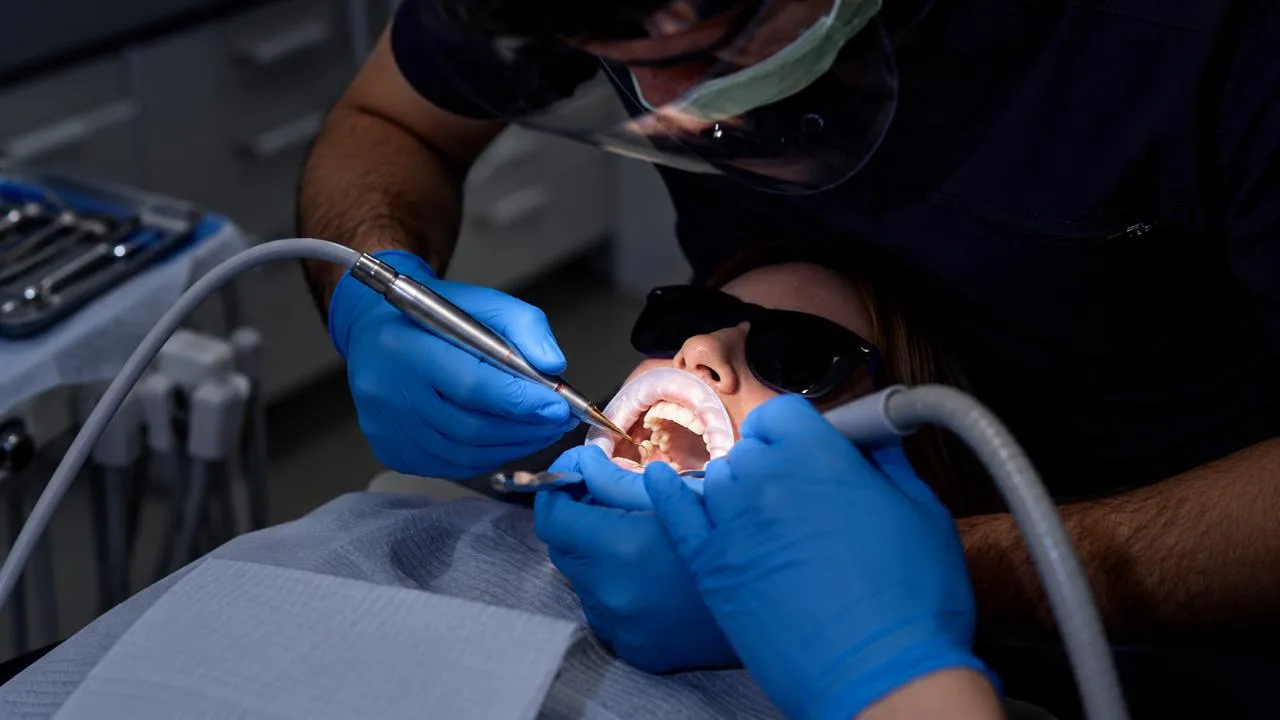
- The procedure – under local anaesthetic. We remove wisdom teeth gently, using the VarioSurg 2 piezosurgery unit from NSK when it is indicated. If needed, the dentist makes a gum incision and places stitches.
- Written aftercare instructions and a check-up – usually after 7–10 days, when the stitches are also removed.
Surgical procedures are performed by:
- Orest Shtuka, dentist – in practice since 2000; oral surgery, implantology and surgical periodontics. Sees patients in Polish, Ukrainian and Russian.
- Rusłan Osmanov, dentist – in practice since 2016; including tooth extraction, implantology and prosthodontics. Sees patients in Polish, English, Russian and Ukrainian.
How much does wisdom tooth removal cost
The cost of wisdom tooth removal depends on whether the tooth has erupted or is impacted in bone, and how close it lies to the nerve canal or the sinus. In private clinics in Poland, wisdom tooth removal usually starts at a few hundred złoty, and removing an impacted tooth costs more. Current prices at our clinic are on the page tooth and wisdom tooth extraction at LumiDent. The dentist gives the exact cost after the examination – before starting the procedure.
Do you have a wisdom tooth that hurts, or are you unsure whether it needs to come out? Book a consultation online or call +48 732 205 427. We are open Monday to Saturday, 10:00–21:00, ul. Alternatywy 7 lok. U5, 02-775 Warsaw.
This article is for information only and does not replace a consultation with a dentist.
Extractions, wisdom teeth, cysts, apicoectomies.
Questions about oral surgery
Should wisdom teeth be removed preventively?
Usually not. The British NICE guidance has long advised against removing healthy impacted wisdom teeth "just in case", and a 2020 Cochrane review found no strong evidence either for or against it. The dentist may still suggest removal when a wisdom tooth cannot be cleaned, damages the neighbouring tooth or gets in the way of planned treatment.
Do wisdom teeth cause crowding of the front teeth?
Research does not support this. In a randomised trial described in the Cochrane review, removing wisdom teeth in teenagers after orthodontic treatment made no meaningful difference to the alignment of the lower front teeth after five years. Teeth can shift with age for many reasons, so crowding alone is usually not a reason to remove a wisdom tooth.
What is the best age to have a wisdom tooth removed?
There is no single best age for wisdom tooth removal. If the tooth is causing problems, it is usually not worth waiting long: with age the roots are longer, the bone is harder, and studies show the risk of complications and nerve irritation rises in older patients. A healthy wisdom tooth does not need removing because of age alone – regular check-ups are enough.
Does wisdom tooth removal hurt?
Wisdom tooth removal is done under local anaesthetic, so during the procedure patients usually feel only pressure and vibration. Once the anaesthetic wears off, there may be pain, swelling and difficulty opening the mouth wide for a few days, usually longer after an impacted tooth. The dentist will tell you which painkillers to take.
Are upper wisdom teeth easier to remove than lower ones?
Usually, yes. An upper wisdom tooth more often has simpler roots and less dense bone around it, and the inferior alveolar nerve does not run nearby. The distance to the maxillary sinus must be checked instead. A lower wisdom tooth is more often impacted in bone and close to the nerve canal, so its removal is usually planned from an X-ray and sometimes a CT scan.
Can a wisdom tooth be removed while it is inflamed?
It depends on how severe the inflammation is. With acute gum inflammation around the wisdom tooth, facial swelling or fever, the dentist usually treats the infection first and schedules wisdom tooth removal once it has settled. With milder symptoms the procedure may be possible straight away. The dentist decides after an examination, so with pain and swelling it is worth coming in quickly.
How long does wisdom tooth removal take?
Removing a wisdom tooth that has fully erupted usually takes around fifteen minutes, like other simple extractions. An impacted wisdom tooth in bone requires a gum incision, sometimes sectioning the tooth and stitches, so it takes longer. The dentist gives the exact time after the examination and X-ray; the check-up and stitch removal are usually after 7–10 days.
Related articles
Ultrasonic tooth extraction (piezosurgery) – how it works and how it differs from a conventional extraction
Ultrasonic tooth extraction uses a piezosurgery tip that cuts bone while sparing the gum. Often less swelling afterwards, but the procedure takes longer.

Toothache – what to do? What helps right away and when to see a dentist
For toothache, take ibuprofen or paracetamol as the leaflet says and book a dentist; if swelling spreads to the neck or breathing is hard, call 112.
- NICE – Guidance on the extraction of wisdom teeth (TA1), 2000
- Ghaeminia H. et al. – Surgical removal versus retention for the management of asymptomatic disease-free impacted wisdom teeth. Cochrane Database Syst Rev, 2020
- Revuelta-Cortés P. et al. – Prevalence of distal caries in second molar associated with impacted mandibular third molar: a systematic review and meta-analysis. Clin Oral Investig, 2025
- Sarikov R., Juodzbalys G. – Inferior alveolar nerve injury after mandibular third molar extraction: a literature review. J Oral Maxillofac Res, 2014
- Kang F.W. et al. – Coronectomy in Lower Third Molar Surgery: A Systematic Review and Meta-Analysis. J Oral Maxillofac Surg, 2025
- Taberner-Vallverdú M. et al. – Efficacy of different methods used for dry socket prevention and risk factor analysis: A systematic review. Med Oral Patol Oral Cir Bucal, 2017