Implant or bridge – which should you choose for a missing tooth?
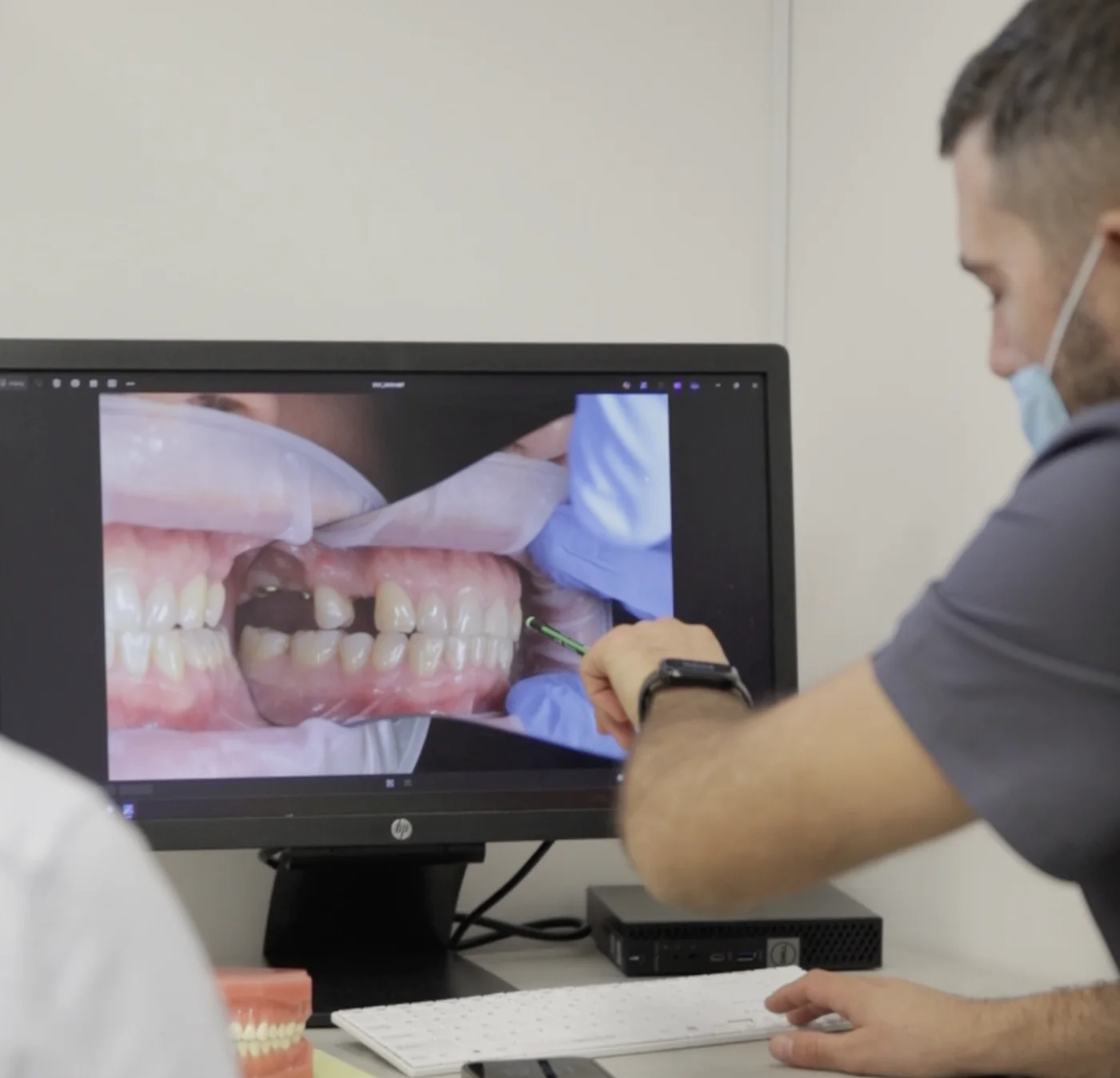
Implant or bridge? Both permanently replace a missing tooth, but they work differently: an implant replaces the root and does not require grinding down the neighbouring teeth, while a bridge rests on the teeth on both sides of the gap. Which option is better depends on the condition of those teeth, the amount of bone and your general health.
Implant or bridge: how each one works
An implant is a titanium or zirconia screw placed in the bone where the lost root used to be. After healing, which usually takes a few months, the dentist attaches a crown to it. Each implant transfers chewing forces directly to the bone, much like a natural root.
A bridge consists of joined crowns. The end crowns are fitted on the teeth next to the gap (abutments), and the middle one fills the gap. For the crowns to fit on the abutments, these teeth have to be ground down.
Implant or bridge – comparison
| Criterion | Dental implant | Bridge |
|---|---|---|
| Neighbouring teeth | Not ground down | Ground down for crowns |
| Bone at the gap | The implant transfers load to the bone | Bone under the pontic is not loaded and may shrink over time |
| Surgical procedure | Yes, under local anaesthesia | No |
| Treatment time | Usually 3–6 months, longer with bone grafting | Usually 2–3 visits over a few weeks |
| Survival after 10 years (studies) | Approx. 93–96% of implants still in use | Approx. 89% of bridges still in use |
| If a problem occurs | Usually affects one implant or crown | Often the whole bridge has to be removed |
| Hygiene | Like a natural tooth | Requires cleaning under the pontic |
When an implant is usually a better choice than a bridge
An implant is most often considered when the teeth next to the gap are healthy. Grinding down healthy teeth for a bridge means irreversible loss of their tissue. An implant is also an option when there is no tooth on one side of the gap that could serve as an abutment.
For people who are missing all the teeth in an arch, the All-on-X solution is used. A fixed bridge then rests on several implants – usually four to six.
When a bridge instead of an implant makes sense
A bridge can be a reasonable choice when the neighbouring teeth need crowns anyway, for example because they are heavily restored or have had root canal treatment. Grinding down such teeth is then not an additional loss.
A bridge is also considered when an implant is not possible for health reasons, or the patient does not want surgery or bone grafting. It may also be chosen when a tooth needs to be replaced quickly and several months of implant healing are not an option.
It is also worth remembering that a bridge joins several teeth into one unit. If one of the abutments develops a problem, for example decay under the crown, treatment often requires removing the whole bridge.
Implant, bridge or nothing? What if you leave the gap
A missing tooth does not always need immediate treatment. In a study published in the journal of the American Dental Association, most patients with a single gap in the back teeth had only small changes over several years: the teeth usually moved by a millimetre or less.
This does not mean, however, that the gap makes no difference. Over time the bone at the gap may shrink, and the neighbouring and opposing teeth may tilt or over-erupt. The more bone is lost, the harder it is to place an implant later without bone grafting. That is why the decision to treat, or to postpone treatment, is best made after an examination rather than by guesswork.
Implant or bridge – treatment step by step
Implant treatment usually looks like this:
- Consultation, examination and imaging (X-ray or CT scan).
- Preparation if needed: gum treatment, bone grafting or sinus lift.
- Placing the implant under local anaesthesia.
- Healing, usually several months. During this time you can wear a temporary restoration.
- Scan or impression and fitting the crown on the implant.
Bridge treatment is shorter:
- Consultation and assessment of the abutment teeth, with root canal treatment if needed.
- Grinding down the abutments under local anaesthesia, scan or impression, temporary bridge.
- Try-in and fitting the bridge, usually after one to two weeks.
Implant or bridge – which lasts longer?
Both methods are durable, and data from research reviews are slightly more favourable for implants over the longer term:
- Implants: according to a 2019 systematic review, approx. 93–96% of implants are still in use after 10 years. In people over 65, this rate was slightly lower. After 20 years, according to a 2024 meta-analysis, about four out of five implants are still functioning.
- Bridges: according to a systematic review, approx. 89% of bridges are still in use after 10 years, but only approx. 71% had no complications during that time. The most common causes of problems are the bridge coming loose, decay under a crown and a fractured abutment.
Keep in mind that a crown on an implant, like any crown, may need replacing after some years. The durability of both options depends most on hygiene, regular check-ups and smoking.
How to care for an implant and a bridge
An implant is cleaned like a natural tooth: with a toothbrush, floss or interdental brushes. The most important thing is keeping the gums around the implant healthy, because chronic inflammation can lead to bone loss.
With a bridge you also need to clean the space under the pontic. Special floss with a stiffened end or a water flosser is used for this. In both cases, professional cleaning and a check-up are usually recommended every six months.
Dental implant: who it is for, and when not
An implant is not for everyone. The dentist may postpone or advise against treatment in cases of uncontrolled diabetes, certain medications that affect bone, untreated gum disease or heavy smoking. The decision is made after an examination and imaging.
How much does an implant cost compared with a bridge
The cost of an implant usually includes placement, the abutment and the crown. With a bridge you pay for each crown, including the crowns on the abutment teeth. A three-unit bridge and a single implant with a crown may therefore cost about the same. The difference depends on the number of missing teeth and whether bone grafting is needed.
When comparing costs, it is worth looking at the longer term. If the bridge has to be replaced after some years or an abutment tooth needs treatment, the total cost goes up. You will find crown and bridge prices on the crowns and bridges page.
Implant or bridge at LumiDent
Treatment starts with a consultation, during which the dentist assesses the teeth, gums and amount of bone and discusses both options. At LumiDent, implants are placed by Dr Orest Shtuka, Dr Nikita Kudinov and Dr Rusłan Osmanov. We describe the course of treatment, indications and prices on the dental implants in Ursynów page. If you are worried about the procedure itself, also read the article Does implant placement hurt? (PL).
This article is for information only and does not replace a consultation with a dentist.
Replacing missing teeth with implants, including All-on-X.
Questions about dental implants
Is a dental implant more durable than a bridge?
In studies, implants do slightly better. After 10 years, approx. 93–96% of implants and approx. 89% of bridges are still in use, although bridges more often have complications along the way, e.g. coming loose or decay of an abutment. The durability of both options depends most on hygiene, regular check-ups and not smoking.
Can an implant be placed many years after losing a tooth?
Often, yes. After a tooth is lost, however, the bone in that area may shrink over time. If there is too little of it, the dentist may suggest bone grafting before the implant is placed, or a sinus lift in the upper jaw. Whether this is needed is shown by the CT scan taken during diagnosis.
Is a bridge instead of an implant a good option when the neighbouring teeth have crowns?
This is one of the situations where a bridge makes the most sense. If the teeth on both sides of the gap are already heavily restored or have crowns, grinding them down does not mean an additional loss of healthy tissue. The dentist must, however, assess whether these teeth are strong enough to carry a bridge for years.
Does implant placement hurt?
The procedure is done under local anaesthesia, so during implant placement the patient usually feels pressure rather than pain. For a few days after the procedure there may be swelling and discomfort, which usually ease with ordinary painkillers. The dentist gives you instructions for the healing period.
How long does implant treatment take compared with a bridge?
Implant treatment usually takes 3 to 6 months, because the implant has to fuse with the bone. With bone grafting it may take longer. A bridge can usually be made in 2–3 visits over a few weeks. While the implant heals, you can wear a temporary restoration.
Related articles
- Howe M.-S. et al. – Long-term (10-year) dental implant survival: a systematic review and sensitivity meta-analysis. Journal of Dentistry, 2019
- Kupka J.R. et al. – How far can we go? A 20-year meta-analysis of dental implant survival rates. Clinical Oral Investigations, 2024
- Tan K. et al. – A systematic review of the survival and complication rates of fixed partial dentures (FPDs) after an observation period of at least 5 years. Clinical Oral Implants Research, 2004
- Shugars D.A. et al. – The consequences of not replacing a missing posterior tooth. Journal of the American Dental Association, 2000