Do veneers ruin your teeth? What really happens to a tooth under a veneer
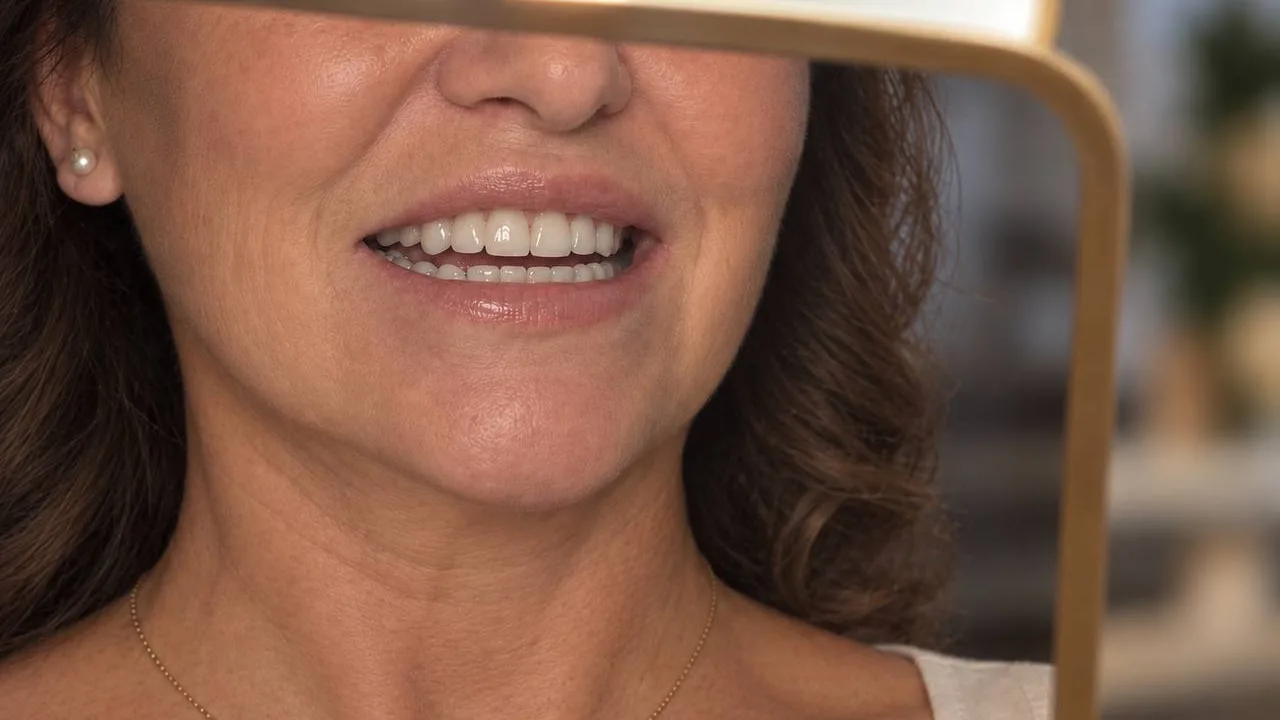
Do veneers ruin your teeth? Well-planned veneers do not ruin healthy teeth: porcelain veneers usually need only a thin layer of enamel removed, and bonding is often done with no grinding at all. The risk appears when preparation is too deep, when veneers are used to "straighten" crooked teeth, or when they are placed on teeth with untreated decay or unhealthy gums.
It is one of the first questions we hear at a consultation. Many people have seen photos online of teeth ground down to stumps and are afraid that veneers mean losing their own teeth. In this article we explain how much tooth tissue is really removed for veneers, how porcelain and bonding differ in this respect, what the real risks are and how to reduce them.
Do veneers ruin your teeth? What happens to a tooth under a veneer
A veneer is a thin layer of porcelain (ceramic) or composite bonded to the front surface of a tooth. It changes the tooth's shape, colour and length, but the tooth underneath stays alive: it keeps its nerve, root and gum, just as before treatment.
For a veneer to hold firmly for years, it needs a good surface to bond to. The best surface is enamel, the hard outer layer of the tooth. Underneath lies dentine, to which adhesive bonds less predictably. So whether a veneer "harms" a tooth depends above all on how much enamel is left after preparation.
In a study of 580 porcelain veneers followed for up to 12 years, veneers bonded to dentine or with margins in dentine were about 10 times more likely to fail than veneers bonded to enamel. That matters for the patient too: the more of your own enamel is kept, the better for both the tooth and the veneer.
How much enamel is removed for porcelain veneers
For a porcelain veneer the front surface of the tooth is usually reduced by a few tenths of a millimetre. The exact depth depends on how the teeth are positioned, their colour and how much they are meant to change.
Enamel on the front teeth is thin, especially near the gum. In a laboratory study on extracted upper central incisors, preparation of about 0.3 mm near the gum, 0.5 mm in the middle and 0.7 mm at the edge still stayed entirely within enamel. With deeper preparation, more and more of the surface reached the dentine. On lateral incisors and canines the limits were different, so the depth is not chosen "by eye" for all teeth alike.
What helps save enamel:
- Smile design and mock-up. When the dentist first plans the new tooth shape and tries it in the mouth, they can prepare the tooth only where the veneer really needs space. This is described, among others, in work on the so-called additive wax-up.
- Adding instead of removing. If teeth are to be longer or wider, minimal preparation or none at all is often enough: material is "added" to the tooth.
- Orthodontics first for crooked teeth. A veneer on a protruding or rotated tooth usually needs much deeper preparation. We write more about this in the article Veneers or braces (PL).
Enamel does not grow back, so preparation for porcelain veneers is irreversible. That does not mean the tooth is "ruined", but it does mean it will need a veneer or another restoration in the future.
Bonding (composite veneers): veneers without grinding?
Bonding means composite veneers made directly in the dental chair. The dentist applies material to the tooth and sculpts the shape, and the tooth often does not need grinding at all, or only minimal smoothing of the enamel. That is why bonding is usually the most tooth-sparing way to change a tooth's shape.
Bonding has its limits, though:
- composite loses its shine over time, can stain at the margins and chips more often than porcelain: in a 6-year clinical study composite veneers needed such corrections, although they were rated as successful,
- it needs polishing and small repairs from time to time,
- it is not entirely "traceless": when composite is removed from a tooth, a little enamel is easily removed as well, so replacing bonding also takes precision.
No-prep porcelain veneers: when are they possible
There are also very thin porcelain veneers that are bonded with no tooth preparation, or almost none. They work mainly when the teeth are small, there are gaps between them or the enamel is worn and needs "rebuilding".
They are not a solution for everyone, though. If the teeth protrude or are very dark, a no-prep veneer would be too thick and could look unnatural or make cleaning near the gum harder. In a review of studies comparing both types of veneers, the most common problems with no-prep veneers were chipping at the margins and debonding.
When veneers can harm your teeth: the real risks
Research on porcelain veneers is fairly reassuring. In a systematic review of 25 studies with more than 6,000 veneers, the estimated share of veneers still in service after 10 years was about 95%. Secondary decay and the need for root canal treatment were rare reasons for failure in these studies, each affecting about 1% of veneers over 10 years. A more recent meta-analysis also reports a low rate of biological complications, that is, those affecting the tooth itself and the gum.
Even so, veneers can cause harm when:
- Preparation is too deep. Preparation into dentine increases the risk of debonding, sensitivity and, in extreme cases, irritation of the pulp.
- Veneers are meant to replace braces. Masking crooked teeth usually requires removing much more tooth tissue.
- Teeth or gums are not healthy. Veneers are placed only after decay and gum inflammation have been treated.
- Veneer margins are too thick or poorly sealed. Plaque builds up more easily in such places, which encourages decay and gum inflammation.
- Teeth are under heavy load. With grinding and clenching (bruxism), veneers fracture or come off more often.
The most common problems with porcelain veneers themselves are fractures and debonding, usually in the first years. A veneer that has come off can often be bonded again, and a fractured one replaced.
Porcelain veneers and bonding compared
| Bonding (composite veneers) | Porcelain veneers | |
|---|---|---|
| Tooth preparation | Often none, or minimal | Usually a thin reduction of enamel |
| Reversibility | Partial: composite can be removed or replaced | Irreversible: the tooth will need a restoration |
| Repair | Usually in the clinic, in one visit | A veneer that came off can often be rebonded; a fractured one is replaced |
| Appearance over time | May lose shine and stain at the margins | Keeps its colour and shine better |
| Visits | Usually one or a few, depending on the number of teeth | Usually at least two: preparation with a scan, then fitting |
Current prices for both methods are on the page porcelain veneers and bonding at LumiDent.
Who veneers are not a good idea for
- people with untreated decay or gum inflammation, which must be treated first,
- people with clearly crooked teeth or a bite problem who want to "skip" orthodontic treatment,
- people with severe bruxism, until the teeth are protected, for example with a night guard,
- people who are bothered only by the colour of healthy teeth: sometimes professional teeth whitening is enough, with no grinding at all.
This is general information. The final decision is always made by the dentist after an examination.
How to care for teeth with veneers so they stay healthy
A veneer does not protect a tooth against decay or gum disease. Teeth with veneers need the same hygiene as the others:
- brushing twice a day and cleaning between the teeth with floss or interdental brushes,
- regular professional cleaning and check-ups, at which the dentist examines the veneer margins and the gums,
- not biting hard objects (pens, nails, seeds) with the front teeth,
- a night guard, if the dentist recommends one for teeth grinding.
Veneers at LumiDent: how we plan treatment to spare your teeth
At LumiDent in Ursynów, porcelain veneers and bonding are done by Dr Rusłan Osmanov. Before we prepare anything:
- we examine your teeth and gums and talk about what you would like to change,
- if needed, we prepare a Digital Smile Design and a mock-up, so you can see the planned result in your mouth,
- we discuss whether bonding is enough in your case or porcelain veneers would be better, and how much enamel would need to be prepared,
- if needed, we first treat decay or do a professional cleaning or whitening.
Want to find out whether veneers or bonding would be safe for your teeth? Book a consultation online or call +48 732 205 427. We are open Monday to Saturday, 10:00–21:00, ul. Alternatywy 7 lok. U5, 02-775 Warsaw.
This article is for information only and does not replace a consultation with a dentist.
Porcelain veneers, bonding, DSD smile design.
Questions about veneers and bonding
Can teeth decay under veneers?
A tooth under a veneer can still decay like any other tooth, especially at the edge of the veneer, where plaque builds up. In studies, however, decay is a rare reason for replacing porcelain veneers. What matters most is careful brushing, flossing, regular professional cleaning and check-ups at which the dentist examines the veneer margins.
Do teeth look worse than before once veneers are removed?
After porcelain veneers a tooth usually has a thinner layer of enamel than before treatment, so it is not left without a restoration: it gets a new veneer or another restoration. Bonding can usually be removed or replaced more easily, although removing composite can also take away a small amount of enamel.
Do veneers hurt or cause sensitivity?
Tooth preparation for veneers is usually done under local anaesthetic, so the procedure itself should not hurt. Afterwards a tooth may react to cold for a few days, especially if preparation reached the dentine. With shallow preparation in enamel, and with bonding, sensitivity is less common. If it does not go away, see your dentist.
Can veneers be placed without grinding the teeth?
Sometimes. Bonding is often done with no preparation or only minimal smoothing of the enamel. Thin porcelain veneers without preparation (so-called no-prep veneers) are possible mainly for small teeth, gaps between teeth or worn enamel. Protruding or dark teeth usually need at least some preparation so that the veneer is not too thick.
How long do porcelain veneers last?
In a systematic review of 25 studies with more than 6,000 porcelain veneers, the estimated share of veneers still in service after 10 years was about 95%. The most common problems were fractures and debonding, usually in the first years. Composite veneers lose their shine sooner and more often need polishing or repair.
Can I have veneers if I grind my teeth?
With bruxism, veneers are more prone to fracture and debonding, but you do not always have to give them up. The dentist assesses how heavily the teeth are loaded, chooses the material and often recommends a night guard. With severe grinding, bruxism is sometimes treated first, and veneers or bonding are planned afterwards.
From what age can veneers be placed?
Veneers are usually placed in adults, once the teeth have fully erupted and the gums are stable. In young people with healthy teeth dentists are more cautious about removing enamel and more often suggest no-prep options, whitening or orthodontic treatment. What is right in a particular case is decided by the dentist after an examination.
Related articles
Ceramic inlays, onlays and overlays – why they are not "ceramic fillings" and when they are used
Inlays, onlays and overlays differ in how much of the tooth they cover. When a lab-made ceramic restoration is a better choice than a large filling.
Related serviceVeneers and bonding in Warsaw Ursynów
Porcelain veneers and bonding (composite veneers) change the shape, colour and length of the front teeth. Before treatment you can see the planned result in a Digital Smile Design project.
- Alenezi A. et al. – Long-Term Survival and Complication Rates of Porcelain Laminate Veneers in Clinical Studies: A Systematic Review. J Clin Med, 2021
- Klein P. et al. – Survival and Complication Rates of Feldspathic, Leucite-Reinforced, Lithium Disilicate and Zirconia Ceramic Laminate Veneers: A Systematic Review and Meta-Analysis. J Esthet Restor Dent, 2025
- Gurel G. et al. – Influence of enamel preservation on failure rates of porcelain laminate veneers. Int J Periodontics Restorative Dent, 2013
- Gao J. et al. – Three-dimensional Quantification of Enamel Preservation in Tooth Preparation for Porcelain Laminate Veneers. Oper Dent, 2022
- Magne P., Magne M. – Use of additive waxup and direct intraoral mock-up for enamel preservation with porcelain laminate veneers. Eur J Esthet Dent, 2006
- Hameed F.F. et al. – Clinical Outcomes of No-prep Veneers and Conventional Veneers: A Systematic Review. J Contemp Dent Pract, 2025
- Bilen H., Turkun L.S. – 6-year clinical performance of prefabricated and clear template-formed resin composite veneers. Clin Oral Investig, 2025
- Guarnieri F.D.F. et al. – Use of auxiliary devices during retreatment of direct resin composite veneers. PLoS One, 2021