Ceramic inlays, onlays and overlays – why they are not "ceramic fillings" and when they are used

What people often call "ceramic fillings" are in fact ceramic inlays, onlays and overlays. A dental laboratory makes them from a scan or impression of the tooth, and the dentist bonds them to the tooth. They are a stronger, longer-lasting replacement for a filling in back teeth with a large cavity.
At a consultation patients often hear three unfamiliar words – inlay, onlay, overlay – without knowing how they differ from a filling or why they cost more. In this article we explain how a ceramic inlay differs from a filling, a crown and a veneer, how the three types of inlay differ, what research says about them and when an inlay is really needed.
A ceramic inlay is not a filling – the difference
A filling is made by the dentist directly in the mouth. The dentist places composite in layers into the prepared tooth and cures each layer with light. It is quick, one visit, but with large cavities composite has limits: it shrinks slightly as it sets, and a large chewing surface with cusps and contacts with the neighbouring teeth is harder to rebuild precisely inside the mouth.
A ceramic inlay is made outside the mouth. The dentist prepares the tooth and records its shape, and a dental technician uses it to make a precise ceramic piece that fills the cavity. It is bonded to the tooth with a special composite cement, so that it becomes one unit with the tooth. At LumiDent inlays are made of zirconia – one of the strongest dental ceramics.
That is why "ceramic filling" is not quite the right term. It is sometimes also used for an ordinary composite filling with ceramic filler particles – but that is still a filling placed in the mouth. If you hear about "ceramic" at a consultation, it is worth asking whether it means a laboratory-made inlay.
Ceramic inlay, crown and veneer – what each is for
All three are made in a laboratory, but they do different jobs:
- A crown covers the whole tooth. It is used when the tooth is badly damaged and an inlay can no longer hold it together. For a crown the tooth is reduced on all sides.
- A veneer is a thin shell on the front surface of front teeth, in the smile zone. It does not cover the whole tooth; it changes its shape and colour.
- A ceramic inlay rebuilds part of a tooth – usually a back tooth – when the cavity is too large for a filling but the tooth does not yet need a crown.
Ceramic inlays, onlays and overlays – the difference
The three types of ceramic inlay differ in how much of the tooth they rebuild:
- Inlay – sits inside the tooth. It fills the cavity between the cusps, and the cusps themselves remain your own. It suits teeth with strong walls.
- Onlay – covers one or more cusps. It is chosen when a cusp is weakened, chipped or its wall is too thin to withstand chewing forces.
- Overlay – covers the whole chewing surface, including all cusps. It is a step between an onlay and a crown: the tooth is protected from above, but its side walls are usually not reduced all the way round as for a crown.
The dentist decides which option fits only after removing the old filling and decay – the real size of the cavity often becomes clear only then.
Ceramic inlay, filling and crown – comparison
| Filling | Ceramic inlay (inlay, onlay, overlay) | Crown | |
|---|---|---|---|
| Where it is made | directly in the mouth | in a dental laboratory | in a dental laboratory |
| Visits | usually 1 | usually 2 | usually 2 |
| For which cavities | small and medium | large, weakened or chipped cusps | badly damaged tooth |
| How much tooth is removed | only decay and the old filling | the cavity plus space for the ceramic | the tooth on all sides |
| Strength and lifespan | lower with large cavities | high | high |
| Appearance over time | may lose shine and colour | usually keeps colour and shine better | depends on the material |
| Cost | lower | higher than a filling | usually higher than an inlay |
The key point: a ceramic inlay is a more expensive, but stronger and longer-lasting replacement for a filling – where a filling is at its limit and a crown is not yet necessary. Current prices for inlays and crowns are on the page ceramic inlays, onlays, overlays and crowns at LumiDent.
What research says about ceramic inlays
- Lifespan. In a 2016 meta-analysis (14 studies with more than 5 years of follow-up), the estimated survival of ceramic inlays, onlays and overlays was 92–95% after 5 years and 91% after 10 years. These studies mainly involved glass-ceramics and feldspathic porcelain. The most common problem was fracture or chipping of the ceramic (about 4%), less often complications of the tooth's nerve (about 3%), secondary decay and debonding (about 1%).
- How much tooth is kept. In a laboratory study on model back teeth, an MOD inlay (covering three surfaces) removed about 27% of the crown of the tooth, while a full crown removed about 68–76%. This is the main argument for an inlay when the tooth allows it.
- Ceramic or composite inlay. Inlays can also be made of composite. In a review of studies from 2004–2013 the average success rate was slightly higher for ceramic restorations than for composite ones (about 96% vs 93%), although a systematic review of randomised trials rated the evidence that ceramic performs better as limited.
In other words, with the right indications a ceramic inlay can last many years – in the studies, 9 out of 10 inlays were still in place after 10 years. How long it lasts depends on choosing the right cases, how the inlay is bonded and how you care for your teeth afterwards.
When a ceramic inlay is a good choice
The dentist usually suggests a ceramic inlay when:
- the cavity is large – for example after removing extensive decay or an old filling on two or three surfaces of a back tooth;
- a cusp is chipped or weakened – an onlay or overlay covers it and lowers the risk of the tooth splitting;
- the tooth has had root canal treatment – such a tooth is more brittle, and back teeth often need their cusps protected;
- a large old filling leaks, there is decay underneath or the walls show cracks;
- you want a long-lasting restoration instead of a large filling that will probably need replacing over time.
We write more about protecting a tooth after root canal treatment on the page root canal treatment at LumiDent.
When a ceramic inlay is not needed or not suitable
- A small cavity. If an ordinary filling seals it well, an inlay often brings no clear benefit – just more drilling, two visits and a higher price. We treat such cavities as part of decay treatment and fillings.
- The tooth is more damaged than an inlay can hold. With thin or deeply cracked walls the dentist will suggest a crown, sometimes with a post and core.
- Untreated decay in other teeth or gum inflammation. These need treating first: a ceramic inlay is bonded to a dry, healthy tooth, and bleeding gums get in the way.
- The edge of the cavity lies deep under the gum. It can be hard to isolate the tooth reliably for bonding there, so the dentist may choose a different solution.
- Heavy tooth grinding (bruxism). This is not always a contraindication, but the dentist may also recommend a night guard.
How a ceramic inlay is placed – step by step
- Consultation and X-ray. The dentist examines the tooth, takes an X-ray if needed and explains whether an inlay, onlay or overlay will work or a crown would be better – and how much it will cost.
- Tooth preparation under local anaesthetic: removing decay and the old filling, strengthening the base of the cavity if needed and shaping it for the inlay.
- 3D scan or impression and shade matching.
- A temporary filling closes the tooth while the laboratory makes the inlay.
- Second visit: the dentist removes the temporary filling, checks the fit, the contacts with neighbouring teeth and the colour, then bonds the inlay with composite cement.
- Polishing and bite check, with a follow-up visit if needed.
There are usually a few days to two weeks between the visits. During that time it is best not to bite into hard foods or chew sticky food on the side with the temporary filling.
How to look after a ceramic inlay
- Brush twice a day and use floss or interdental brushes – decay can develop at the edge of an inlay, as at the edge of any restoration.
- Come for professional cleaning and check-ups: the dentist checks that the edges still fit tightly.
- If you grind your teeth, tell the dentist – a night guard protects both the inlay and your own teeth.
- Do not bite ice, nuts in their shells or other very hard objects.
After bonding the tooth may react to cold for a few days. If the sensitivity does not settle or gets worse, or it hurts to bite, contact the clinic.
Ceramic inlays at LumiDent
At LumiDent in Ursynów, ceramic inlays, onlays and overlays are made of zirconia by a dental laboratory from a 3D scan or impression of the tooth, and we usually place them in two visits. Before we start, the dentist explains which option suits your tooth – a filling, an inlay or a crown – and tells you the cost.
Inlays and crowns are done by:
- Ruslan Osmanov, dentist – in practice since 2016; conservative dentistry, endodontics, prosthodontics and implantology. Sees patients in Polish, English, Russian and Ukrainian.
If you are interested in ceramic restorations for front teeth, read our article do veneers damage your teeth.
A large old filling, a chipped tooth or a tooth after root canal treatment? Book a consultation online or call +48 732 205 427. We are open Monday to Saturday, 10:00–21:00, ul. Alternatywy 7 lok. U5, 02-775 Warsaw.
This article is for information only and does not replace a consultation with a dentist.
Crowns, implant crowns, dentures, posts.
Questions about prosthodontics
Is a ceramic filling the same as a ceramic inlay?
No, although the two are often confused. A filling is made by the dentist directly in the mouth, placing the material in layers. A ceramic inlay – an inlay, onlay or overlay – is made by a dental laboratory from a scan or impression of the tooth and then bonded to it. So rather than a "ceramic filling", it is more accurate to call it a ceramic inlay – a stronger replacement for a filling.
How long do ceramic inlays last?
A ceramic inlay is designed to last many years. In a meta-analysis of studies with more than 5 years of follow-up, ceramic inlays, onlays and overlays survived in about 92–95% of cases after 5 years and 91% after 10 years. How long one lasts in a particular tooth depends on the size of the cavity, your bite, oral hygiene and habits such as tooth grinding.
Does getting a ceramic inlay hurt?
The tooth is prepared for a ceramic inlay under local anaesthetic, just like ordinary decay treatment. At the second visit, when the inlay is bonded, anaesthetic is not always needed – it depends on whether the tooth's nerve is alive. After bonding, the tooth may be sensitive to cold for a few days, which usually settles on its own.
How many visits does a ceramic inlay take?
At LumiDent a ceramic inlay usually takes two visits. At the first, the dentist prepares the tooth, takes a 3D scan or impression and closes the tooth with a temporary filling. The zirconia inlay is made in a dental laboratory, and at the second visit the dentist checks the fit and colour and bonds it to the tooth.
Ceramic inlay or crown – which is better?
If the tooth still has strong walls, a ceramic onlay or overlay often preserves more of your own tooth than a crown, for which the tooth is usually reduced on all sides. A crown is used when the tooth is badly damaged or has thin, cracked walls. The dentist decides after an examination and X-ray.
Can a ceramic inlay be placed on a root-canal-treated tooth?
Yes, it is a common indication. A tooth after root canal treatment is more brittle, so for back teeth the dentist often recommends a ceramic onlay or overlay that covers the cusps, or a crown. If little tooth structure is left, a post and core may be needed first. The dentist chooses the option based on the X-ray and examination.
Can an old filling be replaced with a ceramic inlay?
Yes, a large old amalgam or composite filling in a back tooth is often replaced with a ceramic inlay, especially when it leaks, there is decay underneath or the tooth walls show cracks. Replacing a sound filling only for the colour is not always necessary, though. The dentist will assess whether there is a medical reason to replace it.
Related articles
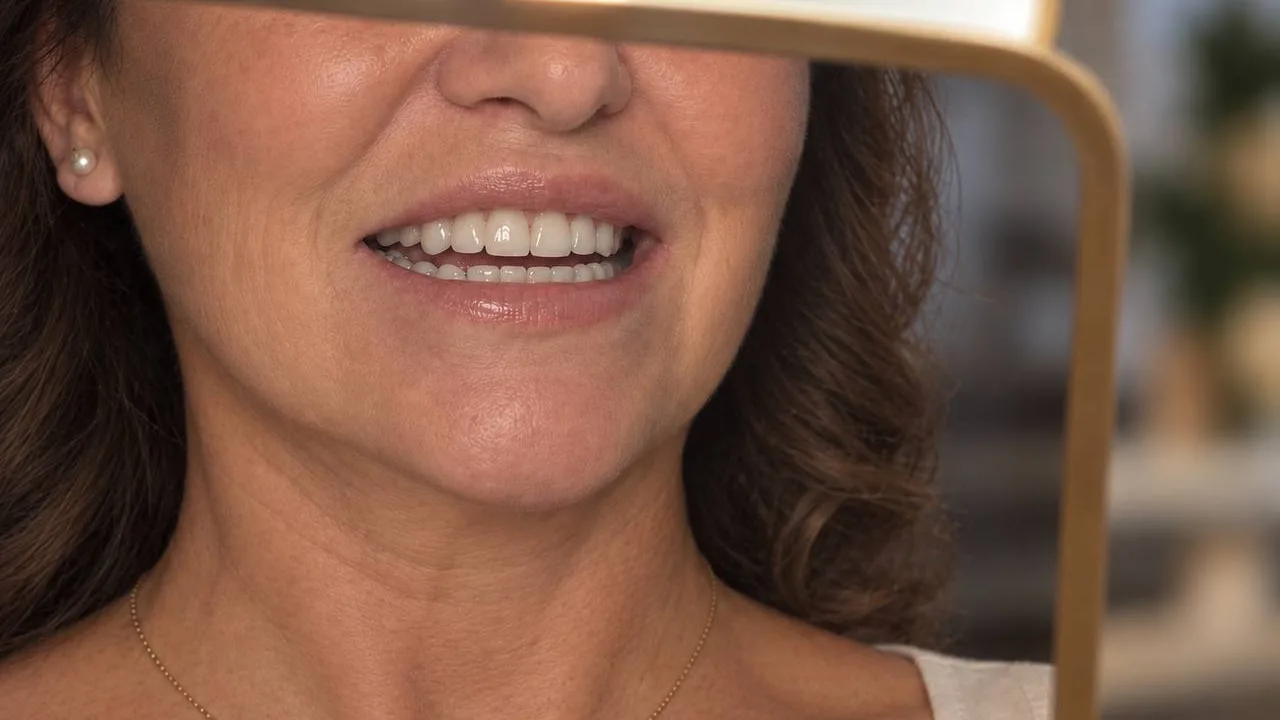
Do veneers ruin your teeth? What really happens to a tooth under a veneer
Usually a few tenths of a millimetre within the enamel – and bonding often needs no grinding at all. When veneers do harm teeth and how to avoid it.

Dental treatment under a microscope – what it offers for caries and when it is worth choosing
Dental treatment under a microscope makes precise work easier, but studies have not confirmed that fillings placed this way last longer.
- Morimoto S. et al. – Survival Rate of Resin and Ceramic Inlays, Onlays, and Overlays: A Systematic Review and Meta-analysis. J Dent Res, 2016
- Edelhoff D., Sorensen J.A. – Tooth structure removal associated with various preparation designs for posterior teeth. Int J Periodontics Restorative Dent, 2002
- Chabouis H.F. et al. – Clinical efficacy of composite versus ceramic inlays and onlays: a systematic review. Dent Mater, 2013
- Mangani F. et al. – The success of indirect restorations in posterior teeth: a systematic review of the literature. Minerva Stomatol, 2015